
3 Case studies: Infections caused by the gram-positive bacilli
Alice Luetchford and Jackie Picard
Sudden death in livestock
Introduction
This is the subject of your first tutorial. Use the chapters on Bacillus and Clostridium species to apply to the four cases investigating bacterial causes of sudden death in livestock.
Case A – Death in Boer goats
In January 2024 in Townsville, 15 young Boer goats from a herd of 150 died over four days. The goats were reared under intensive conditions and fed a high-protein diet supplemented with grain. Post-mortem examination revealed generalised congestion of carcasses and organs, with free fluid in the abdominal and peritoneal cavities. The intestines contained reddish, watery contents, and several goats had duodenal ulcers. Histologically, villi in the duodenum, ileum, and colon were necrotic and heavily infected with coccidian parasites. Numerous gram-positive rods were present. Pulpy kidney was suspected.
Questions
- What risk factors in this herd could have contributed to the outbreak?
- What laboratory tests and results you would expect to confirm pulpy kidney disease in these goats?
Case B – sudden death in cattle in the anthrax belt of Australia
In February 2024, a dairy cattle property near Shepparton, Victoria, experienced sudden deaths in a herd of 200 cows. Five animals died within three days without prior clinical signs. The carcasses exhibited blood-stained exudate at the mouth, nostrils, and anus. Given the property’s location and the clinical presentation, the attending veterinarian suspected anthrax. Shepparton lies in a region historically associated with anthrax outbreaks, particularly in alkaline soils and areas prone to flooding or drought cycles.
Questions
- What should the veterinarian do to immediately confirm his/her suspicions?
- Using a timeline, discuss any actions that should be done to manage suspected cases of anthrax on a farm. This would include any confirmatory diagnoses, reporting and control measures.
Case C – Suspected blackleg in cattle
In November 2024, a beef cattle property in New South Wales which managed 300 head of cattle experienced deaths in its young steers. Eight steers died over a period of 5 days. Some of the beasts soon before they died, were observed to be lame and had a swollen limb. The veterinarian examined the affected limbs and found that they were very swollen, had crepitus and on cutting they were oedematous, seeped blood-tinged fluid and the muscles were necrotic. They also had an unpleasant odour.
Question
You suspect that the deaths in young steers may be due to blackleg (Clostridium chauvoei infection). To help confirm this and rule out other possible causes, what five questions should the veterinarian ask the farmer? For each question, explain how the farmer’s answer would either increase or decrease your suspicion that blackleg is the cause of death. Choose the five most important questions, considering that you have limited time.
Case D – Suspected botulism in sheep
In March 2019, a sheep property in Western Australia housing 500 Merino sheep experienced a sudden increase in mortality. The farm had recently endured severe drought, resulting in poor pasture availability. To supplement feed, the sheep were given hay stored for an extended period in a large shed. Within ten days of starting this hay, sheep developed hindlimb weakness, drooling, hanging heads, sternal recumbency, and died. There are a number of causes of flaccid paralysis that need to be considered including botulism, hypocalcaemia, white muscle disease, ryegrass staggers and plant poisonings.
Questions
- What samples and diagnostic tests can confirm botulism in this flock?
- What immediate treatment and long-term control measures should be implemented to prevent further cases and future outbreaks?
Case studies: Granulomatous disease in livestock
Introduction
To answer these cases studies read through the Chapters on Abscessation in Livestock, Rattles, dermatophilosis and nocardiosis and Mycobacterium Infections.
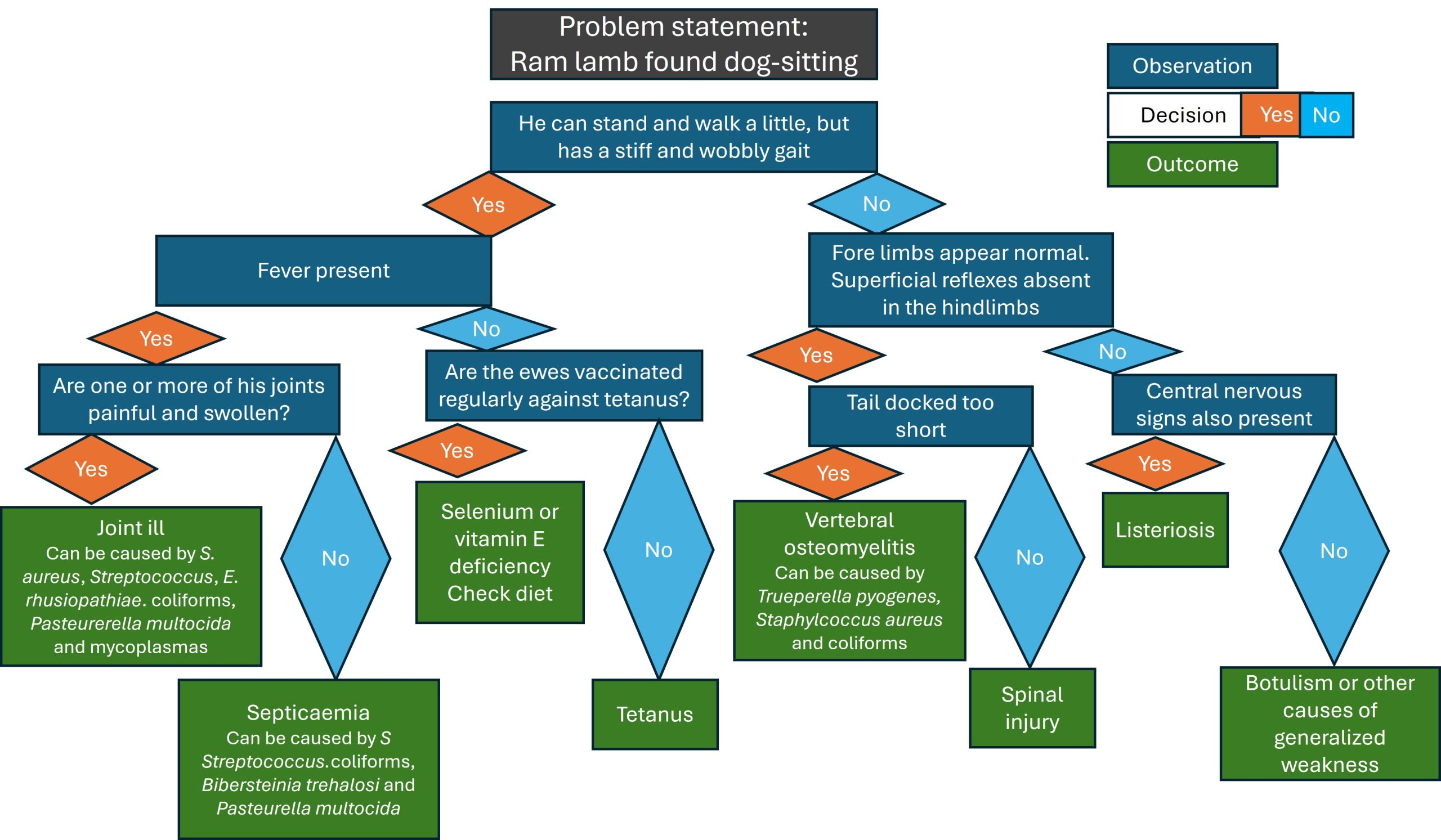
This series of case studies focuses on the differential diagnosis and diagnosis of these diseases. In order to work out how to do this a Decision Tree or Flow-cart can be used. Below is an example of one that can be used to diagnose a cause of sitting disease or hind-limb paresis in sheep.
Case A: Abscessation in sheep
In September 2024, a fine wool Merino farm near Longreach, Queensland, began its shearing season. During this period, shearers observed that at least 10% of the sheep had skin abscesses, and some sheep appeared “light,” indicating potential weight loss or poor body condition.
Question
Create a decision tree that associates epidemiological and management factors and clinical observations with the following potential bacterial aetiologies of abscessation in sheep:
- Corynebacterium pseudotuberculosis
- Trueperella pyogenes
- Staphylococcus aureus
- Actinobacillus equuli
Case B: Chronic respiratory disease in a suckling foal
A 2-month-old Arab colt on a breeding farm in New South Wales started to lag his mother and showed a disinterest in suckling. Clinical examination revealed a fever (39°C) and a high respiratory rate with a mild cough. Thoracic ultrasonography consolidated areas within the lungs.
Differential diagnosis in this case should include the following:
- Precostella equi/Rhodococcus equi the agent of rattles (both names can be used)
- Streptococcus equi subsp. equi, the agent of strangles
- Streptococcus zooepidemicus a cause of pneumonia
- Equine herpesviruses 1 and 4
- Opportunistic bacterial infections such as Actinobacillus equuli and Pasteurella multocida. Both are gram negative bacterial members of the Family Pasteurellaceae.
- Aspiration pneumonia
Question
Create a diagnostic decision tree to help determine the cause of respiratory disease in this foal.
Case C: Emaciation in older sheep
Several 4 tooth or older merino sheep on a property om the Northern Tablelands of New South Wales appeared to be going thin. They had been recently clipped. The wool yield and quality were poorer than for the previous year.
Differential diagnosis in this case should include the following:
- Johne’s disease caused by Mycobacterium avium subsp. paratuberculosis
- Barber pole worm infection
- Nutrition deficiencies
Question
Create a diagnostic decision tree to help determine the cause of wasting in these sheep. Also use this decision tree to detect sheep that are more likely to be suffering from Johne’s disease.
Case D: Ulcerative skin lesions in a cat
A 5-year-old domestic shorthair intact tomcat presented with non-healing ulcerative panniculitis (inflammation of the sub-cutaneous tissue) on his abdomen and flanks. He had been on antibiotic treatment for these lesions for2 weeks a month ago, with no improvement. His body temperature was slightly elevated. The cat had a history of outdoor access and frequent fights with other cats.
Differential diagnosis in this case should include the following:
- Mycobacterium species
- Nocardiosis
- Actinomycosis
- Cryptococcosis (fungal infection)
Question
Create a diagnostic decision tree to help determine the cause of panniculitis in this cat.
A decision tree is a structured diagram that represents a series of decisions and their possible outcomes in a logical, branching format. It starts with a single root node (the main problem or observation) and branches out based on questions or criteria, leading to different paths that end in specific conclusions or actions.