
4 Case studies on Gastrointestinal and Respiratory Disease in Animals
case Studies on Gastrointestinal disease in animals
Introduction
There are a number of infectious and parasitic diseases of animals that cause gastorenteritis in animals. The most common are members of the Enterobacteriales. They are often called coliforms. Most of the information you will require will be found in the Chapter on the Enterobacteriales.
Case A: Diagnostic methods used in the diagnosis of enteric disease
Different diagnostic test types are available to diagnose the cause of infectious diarrhoea in animals. Discuss the uses and limitations of each test type.
- Lateral flow assay
- Multiplex realtime PCR
- Faecal microscopy
- Culture and identification
This is a review and integration of material taught in tv2102. For this you can use the chapter and notes on the diagnosis of bacterial infections, immunological and molecular diagnostic methods associated with studies from tv2102. The chapter on the diagnosis of bacterial infection has been made available to you.
Below is a Table that you could use to fill in your responses.
| Test type | Uses | LImitations | Time to reporting | Cost |
|---|---|---|---|---|
| Lateral flow assay | ||||
| Multiplex realtime PCR | ||||
| Faecal microscopy | ||||
| Culture and identification |
Case B: Colibacilosis in Calves
Four hand-reared heifer dairy calves between 1 to 3 weeks of age are exhibiting signs of a watery diarrhoea and straining to defaecate. Their eyes are sunken, and a pinched skin fold takes more than 3 seconds to flatten. Thus, they are severely dehydrated. The body temperature of one calf is elevated.
Questions
- Although colibacillosis is the most likely disease that these calves are suffering from, list 4 other infectious agents that commonly cause neonatal calf diarrhoea.
- Discuss the most practical ways of treating these calves and preventing further cases of colibacillosis on this farm.
Case C : Salmonellosis in horses
In 2022 a busy veterinary teaching hospital had 28 admitted horses of all ages that stopped eating, develop a high fever and abdominal pain. Within 2 days diarrhoea developed. The horses have increased heart and respiratory rates and congested and brownish mucous membranes. Haematology reveals a marked neutropaenia (low numbers of neutrophils in the blood). Salmonella enterica serovar Typhimurium was isolated from blood cultures of two of the affected horses.
Questions
- What samples should be collected, and tests conducted to maximise the detection of Salmonella in affected horses?
- 256 environmental samples were collected from the equine hospital. The areas where Salmonella was identified are shown in colour with different colours representing different serotypes. Use the results to develop an infection control plan for the hospital.
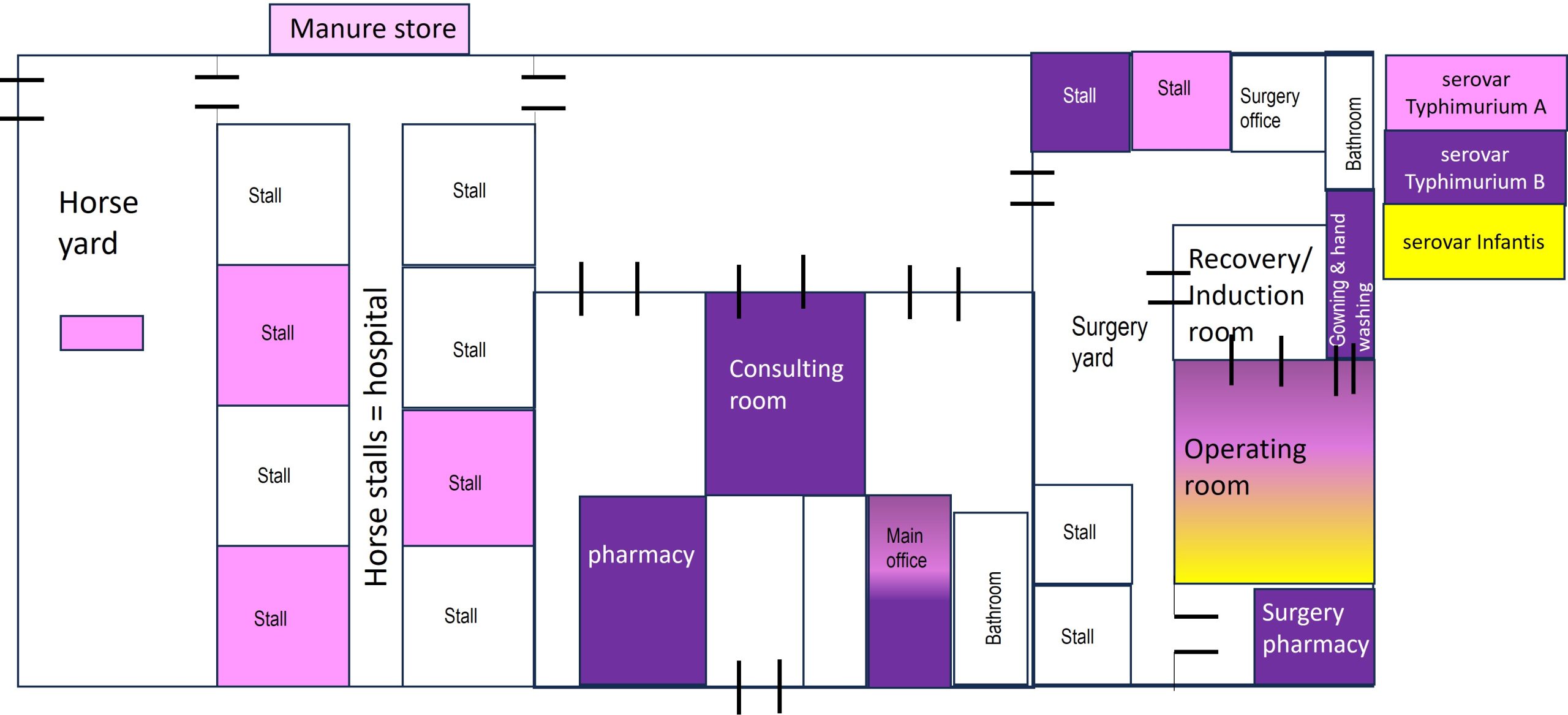
Good infection control plans include a risk assessment, external and internal biosecurity, personal hygiene and PPE, cleaning and disinfection, preventative health, monitoring and surveillance, education and training.
Case D: Yersiniosis in Goats
In December 2020, the owners of a 260-head goat herd in New South Wales observed that several goats of all ages were affected by severe brown watery diarrhoea, poor body condition, and submandibular oedema. Suspecting Haemonchus contortus infection, the owners administered three drenches using a mixture of anthelmintics. Despite treatment, diarrhoea persisted into January, and eight goats (five does, two wethers, and one billy) died.
A veterinarian performed a post-mortem examination on an 18-month-old doe. No internal parasites—helminths or coccidia—were detected. However, the intestines were thickened and showed suppurative enteritis and colitis. Bacterial culture of the affected tissue yielded Yersinia enterocolitica.
Questions
- Differentials for this disease include a chronic form of enterotoxaemia (pulpy kidney) that presents as an intermittent diarrhoea and Johne’s disease. How can these differentials be eliminated as a cause of the disease?
- Yersinosis is an unusual finding. What environmental and managemental conditions would allow this bacterium to be present in high numbers and cause a persistent diarrhoea?
Case Studies on Infectious Respiratory Diseases of Livestock
Introduction
Use the Chapter on the Pasteurellaceae to answer the questions on the four following case studies on respiratory diseases of livestock.
Case A : Bovine Respiratory Disease Complex management of Risk Factors
The bovine respiratory disease complex (BRDC) or “shipping fever” is common in young animals in feedlots and those that are intensively reared. Below is a list of factors that contribute to the development of BRDC.
Question
For each predisposing factor provide a way in which to reduce or eliminate its impact.
| Risk Factor | Control measure |
|---|---|
| Weaning stress | |
| Mustering | |
| Dehorning, castration | |
| Transport over long distances | |
| Mixing of animals from different properties | |
| Excessive dust | |
| Large diurnal temperature variations and wind chill | |
| Change to concentrate rations | |
| Processing | |
| Crowding and social hierarchy changes |
Case B : Bovine Respiratory Disease Complex Host-Pathogen Interactions
Bovine respiratory disease complex is an intricate interaction between host susceptibility, the environment and some viral and bacterial pathogens
Question
Explain how infection with respiratory viruses (bovine herpesvirus 1 (BHV-1), Bovine respiratory syncitial virus (BRSV), Bovine viral diarrhoea virus (BVDV), Parainfluenzavirus 3 (PI3)) predisposes cattle to bacterial bronchopneumonia caused by Mannheimia haemolytica, Bibersteinia trehalosi, Histophilus somni, Pasteurella multocida, and Mycoplasma bovis. Include the mechanisms involved in these interactions.
Although a number of viruses and bacteria are involved, there are a few basic principals on how viruses of the respiratory tract predispose the respiratory tract to bacterial infections. Notes on bacterial viral-bacterial interactions from tv2102 discusses some of these aspects. This chapter will be made available to you.
Case C: Fowl cholera in Free-range chickens
In March 2019, a free-range organic broiler farm in Ayr, Queensland, reported a sudden increase in mortality among its flock. The farm housed approximately 1,000 chickens across several paddocks. However, all deaths occurred in birds from a single paddock. Clinical signs observed before death included depression, ruffled feathers, and greenish diarrhoea. Post-mortem examination revealed septicemia and liver lesions consistent with Pasteurella multocida infection, confirming fowl cholera as the cause.
The farm operates under organic standards, which limit antibiotic use and emphasize natural management practices. The outbreak raised concerns about biosecurity, wildlife interactions, and disease prevention strategies in free-range systems.
Questions
- What factors might have contributed to the outbreak occurring in only one paddock?
- What strategies can be adopted to reduce the risk of future outbreaks in free-range organic poultry systems?
Case D: A unusual cause of Chronic lung lesions in pigs – Discovery of a Novel Pathogen
Between 2015 and late 2016, a pig farm in Victoria, Australia, experienced repeated condemnation of carcasses due to chronic pulmonary and pleural lesions. The affected pigs were 20–24 weeks old and showed no obvious clinical signs before slaughter. Lung abscesses (3–10 cm diameter) and pleural adhesions were observed, resulting in approximately 2% of carcasses being condemned.
Routine testing indicated the farm was free of Mycoplasma hyopneumoniae and major Actinobacillus pleuropneumoniae serotypes (1, 5, 7, 15). A bacterium repeatedly isolated from lesions was identified as a novel species within the family Pasteurellaceae and named Glasserella australis, closely related to Glasserella parasuis (agent of Glässer’s disease). Genomic analysis revealed the presence of the APXIII toxin gene, typically associated with A. pleuropneumoniae.
Questions
- What is the significance of the presence of the APXIII toxin in Glasserella australis?
- How might the discovery of this pathogen influence vaccine development and herd health strategies?
A good infection control plan is a structured strategy designed to prevent and manage the spread of infectious agents in a facility or farm